UPI & Childhood: Nurture Them Right Today, or They Will Find Their Own Substitute Tomorrow

Mantralaya Times News Desk Written by Adv.Dippak P Shah
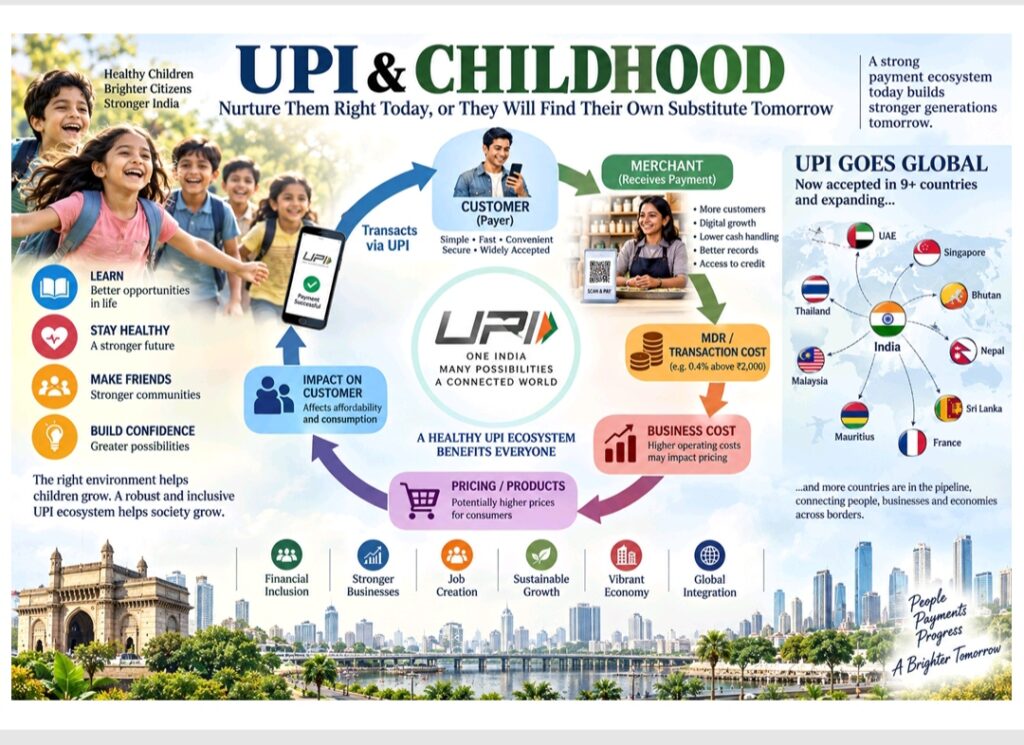
A child needs the right environment to grow. A system like UPI needs the right ecosystem to grow. What we nurture wisely today determines what we accept, use and trust tomorrow.”
“Real childhood is built on the playground, not on the mobile phone” makes us pause and think.
Technology has undoubtedly made life easier. But when convenience starts replacing what is essential, we need to ask ourselves whether we are creating the right environment for the future.
A child needs education, books, outdoor games, physical activity, friends, family interaction and real-life experiences. A mobile phone can be a useful tool, but it should never become a substitute for childhood itself.
The same broader principle can be applied to the way we are building India’s digital payment ecosystem.
UPI has changed the way India transacts.
From large businesses to small shops, auto-rickshaw drivers, roadside vendors and merchants in rural areas, UPI has brought digital payments within everyone’s reach. Its biggest strength has always been its simplicity and convenience.
But whenever a system becomes part of everyday life for millions of people, we must also think about how to nurture it for the long term.
The revised UPI framework introduces a Merchant Discount Rate (MDR) of 0.4% on specified Person-to-Merchant (P2M) UPI transactions above Rs2,000, effective from 15 October 2026. The MDR is capped at Rs 300 per transaction. Person-to-Person (P2P) transactions and P2M transactions up to Rs 2,000 remain outside this MDR framework.
The stated objective is to support the long-term sustainability of the UPI ecosystem, including infrastructure, innovation and security. The MDR is a merchant-side charge and is not intended to be passed on to consumers.
But there is still a practical question worth considering:
How will this additional cost affect the smallest businesses?
A large business may be able to absorb a transaction cost as part of its operating expenses.
But consider: A small trader, An auto-rickshaw driver , A roadside hawker, A small service provider,A rural merchant.
For someone operating on a very narrow margin, even a relatively small additional cost can matter.
The issue, therefore, is not simply whether a charge is imposed on the merchant. The larger question is whether we can design the system in a way that remains simple, transparent and sustainable for everyone, particularly those at the bottom of the economic pyramid.
This is where I believe the Government should think differently.
Instead of allowing payment-related costs to become another complicated component of business economics, policymakers could examine whether a simple, transparent and fixed-cost mechanism could be considered for appropriate categories of transactions.
For example, the Government could study the feasibility of a nominal lump-sum amount, such as Rs3 per applicable transaction, instead of a percentage-based calculation.
This is only a suggestion for consideration—not a proposal that has been announced.
The objective would not be to make UPI expensive.
The objective would be to make the cost simple, transparent and predictable.
If a fixed and clearly disclosed amount were ever considered, users would know exactly what a transaction costs, merchants could plan their expenses more easily, and the system could become easier for ordinary people to understand.
Any such model would, of course, require proper consultation, economic analysis and safeguards for small merchants, low-value transactions, rural users and people operating on very thin margins.
The larger objective should be to protect the very feature that made UPI successful in the first place:
Simplicity.
We should not allow a system built on simplicity to gradually become complicated for the people who depend on it the most.
And this brings us back to the child .
If we give a child only a mobile phone because it is convenient, we may eventually create a generation searching for substitutes for real-life experiences.
Similarly, if we build a digital-payment system without continuously considering the interests of its smallest participants, we should remain alert to whether users and businesses may eventually seek alternative ways of transacting.
Good systems, like good childhoods, need the right environment to flourish.
A child needs a playground along with a mobile phone.
A merchant needs digital convenience along with affordability.
A customer needs speed along with transparency.
And UPI needs innovation along with an ecosystem that remains inclusive.
In the end, one simple principle applies:
“Kayde mein rahoge, toh fayde mein rahoge.”
Whether it is a child, a business or a digital payment system, the right rules, the right balance and the right environment today can create better results tomorrow.
What we build today must
work for everyone tomorrow.
Adv Dippak P Shah